
An oil tanker carrying Saudi crude safely reached Mumbai after crossing the war-hit Strait of Hormuz with its tracking system briefly switched off.

The UN Security Council will vote on a Bahrain-proposed resolution regarding the Strait of Hormuz, aiming to ensure freedom of navigation amid concerns and opposition from some members.

Following the death of Iranian sailors in the Indian Ocean, Iran's navy has threatened 'deadly retaliation,' accusing the US of attacking its warship off the coast of Sri Lanka, escalating tensions in the region.

The threat has raised concerns about possible asymmetric attacks outside the region. Iran has also stepped up attacks on energy infrastructure in Gulf countries.

The ongoing conflict involving the United States, Israel, and Iran intensified sharply with attacks on critical energy infrastructure across the Gulf, even as US President Donald Trump said he had cautioned Israeli Prime Minister Benjamin Netanyahu against targeting Iran's key South Pars Gas Field.

At least eight civilians have been reported killed, and 95 others have sustained injuries following United States-Israeli strikes, Iranian state media Press TV reported.
China has called on Iran to reopen the Strait of Hormuz and expressed appreciation for Tehran's commitment not to develop nuclear weapons, a key demand of the US to end the conflict.
The US torpedo attack on the Iranian warship IRIS Dena in international waters was a lawful act of war between belligerents, not a diplomatic or strategic embarrassment for India, asserts Vice Admiral Biswajit Dasgupta (retd).

Amidst rising Middle East tensions, External Affairs Minister S Jaishankar highlights India's strategic dialogue with Iran to safeguard maritime traffic through the Strait of Hormuz, ensuring India's energy security and continued oil trade.

At least 101 people are missing and 78 are injured after a suspected submarine attack on an Iranian naval ship off Sri Lanka's southern coast on Wednesday, Reuters quoted sources in Sri Lanka's Navy and defence ministry as saying.

External Affairs Minister S Jaishankar has engaged in multiple conversations with his Iranian counterpart to secure safe passage for Indian merchant vessels through the Strait of Hormuz amidst escalating tensions in West Asia.

Aseem Mahajan, Additional Secretary (Gulf) in the Ministry of External Affairs, on Saturday informed that five Indians have been killed and one is missing due to the ongoing conflict in West Asia. He added that Indian missions remain open round the clock and are constantly working to provide assistance.

India granted emergency docking to an Iranian ship, IRIS Lavan, in Kochi due to technical issues, accommodating its crew amidst regional naval activity and tensions.

Amid escalating tensions, Iranian Deputy Foreign Minister Saeed Khatibzadeh declares Iran's unwavering commitment to a 'heroic nationalist defence' against perceived American and Israeli aggression, vowing to resist what he calls an 'invasion' to the very end.

Araghchi remarked that US messaging currently echoes the Vietnam War-era "Five O'Clock Follies," suggesting a systematic misrepresentation of military progress.

24 Indian-flagged vessels with 677 Indian seafarers were currently located west of the Strait of Hormuz, and four vessels with 101 Indian seafarers were stationed east of the strategic waterway.

China has denied any links to the Iranian cargo ship seized by the US in the Gulf, which allegedly contained chemical materials for manufacturing missiles. The denial follows allegations by former US envoy to the UN Nikki Haley, who claimed the ship was headed from China to Iran.

An Indian national was killed in a missile attack on Riyadh, bringing the total number of Indian fatalities in the West Asia conflict to six. The Indian embassy in Riyadh has expressed condolences and is providing assistance to the family.

The Sri Lanka Navy rescued 32 Iranian sailors from a sinking naval ship off the southern coast, while also recovering several bodies. The incident occurred outside Sri Lankan waters but within its search and rescue zone.

President Trump asserts the US military has decimated Iran's forces and no longer requires assistance from NATO allies to secure the Strait of Hormuz, despite earlier requests for support.

Indian stock markets are set to be influenced by ongoing developments in the US-Iran conflict, fluctuations in crude oil prices, and the latest quarterly earnings reports from major corporates, with foreign investor activity also playing a crucial role.

The vessel sank on March 4, 2026, approximately 20 nautical miles west of Galle, after reportedly being struck by a torpedo from a United States submarine.

Chaffing under public ridicule in the US as well as internationally for having 'lost' the war, Trump is under immense pressure to do something, cautions Ambassador M K Bhadrakumar.
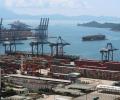
With the Iran war escalating sharply and crisis deepening in the global energy market, India on Monday unveiled a coordinated plan to support exporters and shippers caught in the fallout.

On Saturday, it was reported that a drone strike had targeted the Fujairah Port in the UAE, triggering a fire.
'Torpedoes travel at more than 100 kilometres per hour, about 50-60 knots.' 'It must have been a matter of a few minutes before it detonated under the Iranian ship.' 'The Iranian ship would have probably got three, four minutes and wouldn't have known till they actually heard the whirr of the torpedo.'
It is for the first time that a senior minister has said that Iran requested permission for docking three of its ships in Indian ports.

Is the current rally telegraphing a durable peace plan in West Asia, boosted by United States (US) President Donald Trump's incoherent and contradictory posts on social media?

Defence Minister Rajnath Singh assures India's energy security amidst West Asia tensions, highlighting naval protection of tankers and readiness to counter cross-border terrorism.

'Neither do the Israelis. The two attacking parties have very little economic interest in Hormuz.'

If the oil infrastructure is attacked by the United States, the whole area could be flooded with oil, spilling into the Persian Gulf.

President of the United States Donald Trump on Saturday confirmed that the US had carried out a large strike against Venezuela during which the incumbent President Nicolas Maduro and his wife were captured and taken out of the country.

US President Donald Trump has announced plans to clear the Strait of Hormuz to secure the vital oil corridor, citing risks to global energy supplies and criticising other nations' inaction.

In a post on Truth Social, Trump outlined key goals of the campaign, including degrading Iran's missile capabilities, dismantling its defence industrial base, eliminating naval and air power, preventing Tehran from acquiring nuclear capability, and protecting United States allies such as Israel, Saudi Arabia and the United Arab Emirates.

White House Press Secretary Karoline Leavitt on Tuesday said that the United States has not ruled out the option of sending troops on the ground in Iran and that military operations in the Persian Gulf nation would end once the objectives of Operation Epic Fury are achieved.

'The West Asia or the Gulf crisis has shown that what we develop as national infrastructure when things are not as bad as they could be, we forget to plan for adversities.'

China and Pakistan have jointly proposed a five-point peace plan to address the ongoing conflict in West Asia, focusing on de-escalation and safe passage through the Strait of Hormuz.

'Despite the large number of missiles and drones we have already launched, we still possess reserves and missile cities whose doors have not yet been opened,' says Iran's Consul-General Saeid Reza Mosayeb Motlagh.
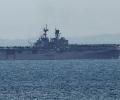
Although extensive air attacks have been carried out to destroy most of Iran's defence capabilities, the latter's resilience and sustenance during the war clearly indicate that the US landing force would encounter severe resistance in the operation, explains Commodore Venugopal Vengalil (retd).

The Ministry of External Affairs (MEA) has confirmed the deaths of six Indian nationals and one missing person amidst the escalating conflict in West Asia, detailing ongoing efforts for repatriation and diplomatic engagement.
